After the ninth China International Import Expo in Shanghai, medical-supply distributors can turn category interest into specific supplier enquiries. This guide uses one-piece ostomy bags and bordered hydrocolloid dressings to explain the product details, indicative volumes and documents to prepare before contacting a supplier.
The ninth China International Import Expo (CIIE) ran from 5 to 10 November 2026 at the National Exhibition and Convention Center in Shanghai. With the event now concluded, purchasing teams can use the industry calendar as a prompt to review their product lists and improve how they approach suppliers. This article is an independent procurement observation, not an account of MDK Medical participating in the event.
A sentence such as “We are interested in ostomy bags and wound dressings” identifies two broad categories. It does not identify the particular catalogue items, intended destination markets, expected purchasing volumes, packaging requirements, or documents the buyer needs to evaluate. Turning that sentence into a useful request for information is a small but important step. The goal is not to make an order prematurely. It is to give both sides a shared, checkable brief for the next discussion.
Why a Broad Product Enquiry Is Not Yet a Procurement Brief
A distributor's first message often reflects an early stage of market research. The buyer may have confirmed that a category is relevant but still be comparing catalogue variants, packaging expectations, or local documentation needs. A supplier receiving only the category name must ask follow-up questions before even identifying which product specification to discuss.
Consider two examples. One buyer asks for “ostomy bags,” while another asks about “hydrocolloid dressings.” Neither request explains whether the buyer is reviewing a particular published catalogue entry or still defining its range. The two product families also use different specification language. For an ostomy pouch, the enquiry may focus on the pouch format, opening range, closure design and backing. For a bordered hydrocolloid dressing, dimensions, shape, border construction and packaging configuration are more relevant starting points.
A workable brief has four core fields: destination market, catalogue reference, configuration details, and documentation requested. Buyers can add an indicative quantity as a separate planning field, clearly marked as a forecast rather than a confirmed purchase order. A clear enquiry gives the supplier an opportunity to verify a specific item rather than respond to an undefined category.
One-Piece Ostomy Bags: Describe the Exact Catalogue Route
MDK Medical's public catalogue has a One-Piece Ostomy Bag collection. The one-piece route presents a pouch with an integrated skin barrier or baseplate. The collection includes distinctions such as closures and backing materials across its listed products. Those catalogue attributes are useful in an RFQ because they help identify what a distributor actually wants information about. They do not establish that every feature is available in every combination.
A purchaser should begin with the collection name and, where possible, the specific product-page reference. The request can then state whether it concerns a drainable or closed pouch, the preferred closure design if relevant, and any opening or cut-to-fit dimension the team intends to evaluate. Where the catalogue uses terms such as clip closure, Velcro closure, paper backing or PET backing, the buyer should reproduce the exact item wording rather than assume the terms are interchangeable.
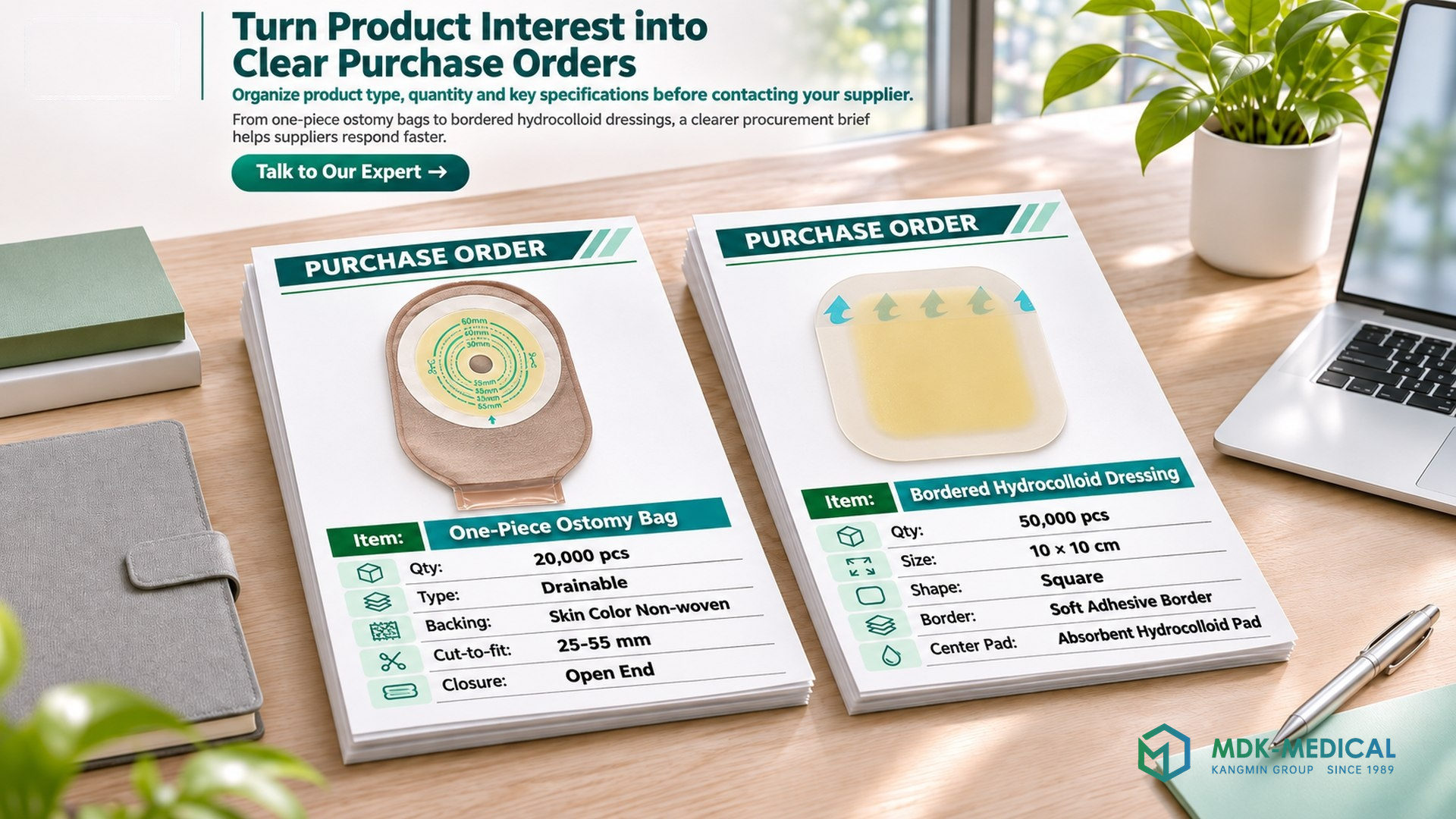
The supplied poster illustrates this with a one-piece pouch photograph on a purchase-order-style sheet. Its example quantity is deliberately fictional; it is a visual shorthand for a buyer preparing a specification list. A real enquiry should make the quantity basis explicit: forecast demand, proposed initial evaluation volume, annual planning estimate, or another category defined by the buyer. None of those entries should be treated as MDK confirmation of supply capacity or order conditions.
It is equally important to keep product identification separate from clinical choice. A distributor can ask what pouch formats appear in the catalogue and which specifications can be supplied for an identified item. Decisions about suitability for an individual patient belong with qualified clinicians and applicable local guidance. The purpose of this article is the commercial information needed for a supplier discussion.
Bordered Hydrocolloid Dressings: Specify Size and Construction
The second product in the approved visual is a bordered hydrocolloid dressing, not a two-piece ostomy system. MDK Medical maintains a Bordered Hydrocolloid Dressing collection, including a published 10 cm × 10 cm variant with a pressed, thin-edge border. Buyers should distinguish this catalogue item from other hydrocolloid dressing formats.
Start a request with the product family and intended size, for example a catalogue-listed 10 cm × 10 cm bordered dressing. Then identify the configuration questions: exact overall dimensions, border design, whether the requested dimension includes the border, inner pad dimensions where specified, and unit packaging. Some of these details may require an item-specific datasheet; they should be recorded as questions for confirmation, not presented as verified facts about every variant.
The approved artwork uses a square bordered-dressing photograph and a sample quantity. Its purpose is to make the information fields easy to understand. It does not depict a verified commercial order and does not certify the dressing's dimensions, labeling, performance or documentation status. If a buyer plans to compare several sizes, the enquiry should list each proposed size as a separate line item and ask the supplier to confirm the corresponding catalogue reference.
For both product groups, the published catalogue is an entry point. Final item characteristics, packaging, labels and applicable quality or regulatory documents need to be checked for the exact product and destination market. Nothing in a generic category description substitutes for that product-specific review. Buyers should resist copying a certification statement from a different page or product onto a new item request.
Five Fields to Include in a Supplier-Ready Request
1. Destination market. State the country or region where the product is intended to be marketed and any known buyer-side documentation or labeling requirements. Regulations vary, so the buyer should identify which requirements its own regulatory or compliance team needs to review. A supplier can then respond to a defined market question rather than guess the jurisdiction.
2. Catalogue item and category. Specify “One-Piece Ostomy Bag” or “Bordered Hydrocolloid Dressing,” and provide a link or clearly described catalogue entry. When asking about both, put them on separate lines. A category name is useful for discovery; a product-level reference is needed for precise technical and document follow-up.
3. Configuration and packaging. For an ostomy pouch, note the pouch format, closure and backing questions that matter to the intended assortment. For a bordered dressing, note dimensions, border construction and unit packaging questions. Include private-label or artwork needs only if relevant to the project. Mark anything that still requires supplier confirmation, rather than silently turning preferences into product specifications.
4. Indicative quantity and planning horizon. State whether quantities are merely forecasts, part of an internal sourcing comparison, or linked to an actual purchasing plan. Distinguish pieces, boxes and cartons wherever applicable; otherwise a figure may be difficult to interpret. The illustrative 20,000-piece and 50,000-piece quantities in the visuals are not MDK minimums, confirmed orders or promises of product availability. Real commercial conditions require a separate response from the supplier.
5. Documents and questions requested. Ask for the relevant product catalogue, item-specific specifications, packaging details and any quality or regulatory documents needed for your market review. Request confirmation of the document's scope, product identity and current status. The supplier may need to clarify which materials apply to a specific product. A request for documents is not a representation that a product holds a particular certification.
A practical enquiry can be written in a few lines: “Destination market: [country]. Product line A: [one-piece ostomy catalogue reference], preferred configuration: [details], indicative quantity: [value and unit]. Product line B: [bordered hydrocolloid dressing reference and size], indicative quantity: [value and unit]. Please confirm the available specifications, packaging and product-specific documents for review.” The brackets are fields for the distributor to fill, not information asserted by MDK.
A Practical Post-Event Preparation Sequence
The weeks following a major trade event are a reasonable time for an importer to tidy its sourcing requests, regardless of whether the importer or any supplier attended. A procurement team can use the following sequence as its own internal checklist; it is not a supplier turnaround schedule or a deadline promised by MDK Medical.
First, consolidate product enquiries into one working register. Group entries by intended market and product family so that unlike items do not become mixed in a single undefined list. Put one-piece ostomy products in one section and bordered hydrocolloid dressings in another. Preserve the original catalogue references, because internal shorthand can become ambiguous when the information is forwarded to another colleague.
Second, ask the product team to flag missing details. An ostomy-bag entry might need clarification about closure format or opening specifications. A dressing entry might need confirmation of overall size, border design or package contents. Make those gaps visible rather than filling them with a guess based on a different product image or an unrelated catalogue description.
Third, have the commercial team identify which quantities represent forecasts and which have completed internal approval. If an enquiry form contains a number, include its unit and planning basis. This helps prevent a marketing illustration, an exploratory forecast or a supplier quotation request from being mistaken for a purchase commitment. Price, delivery, stock and minimum-order terms should remain open until directly confirmed through the appropriate commercial process.
Fourth, have the responsible reviewer prepare a concise document request. Product specifications and destination-market documentation questions should be tied to the actual item, not to a general company profile. Finally, bring the five fields together into one clear message. That message gives the receiving team a useful place to start, even when some answers must still be checked later.
Frequently Asked Questions
Did MDK Medical participate in CIIE 2026? This article does not make that claim. It refers to the conclusion of the ninth CIIE as a date on the industry calendar and focuses on how distributors can prepare clearer purchasing enquiries afterward.
Does the article recommend a product for a particular patient or wound? No. One-piece ostomy bags and bordered hydrocolloid dressings are discussed as catalogue categories for procurement and information requests. Clinical suitability and application decisions require qualified professional assessment and the relevant product instructions.
Are the quantities in the purchase-order graphics actual orders or MOQs? No. The figures are illustrative fields in a conceptual marketing image. They do not describe a customer transaction, supplier minimum order, stock position, accepted price or production commitment.
What documentation can a distributor request? Buyers can ask for the item-specific catalogue, specifications, packaging details and market-relevant quality or regulatory documents. The applicability and availability of each document should be confirmed for the exact item rather than presumed from the product family.
How should a distributor send a structured enquiry? Use the MDK Medical contact form with the destination market, catalogue references, configuration and packaging questions, indicative quantities with units, and a checklist of documents to confirm. Avoid sending patient-identifiable information in an ordinary commercial enquiry.
Conclusion
The most productive step after broad market interest is often a better-defined question. A one-piece ostomy pouch and a bordered hydrocolloid dressing may belong in the same distributor's product plan, but they need different specification fields and item references. A clear written brief keeps product questions, quantities and documentation requests separate so each can be checked properly. MDK Medical's published catalogue pages and contact form provide a practical starting point for a product-specific conversation.
Talk to Our Expert: Prepare your five-field procurement brief and use the MDK Medical contact form linked above to request confirmation of specifications and supporting information for your selected items.


